







Zero-Touch Logistics Orchestration Is Redefining Modern Warehousing
The rise of zero-touch logistics orchestration marks a pivotal shift in how warehouses and distribution centers operate. By combining autonomous systems, real-time data processing, and intelligent software layers, manufacturers and logistics providers are eliminating manual intervention at nearly every stage of the supply chain.
What Is Zero-Touch Logistics Orchestration?
Zero-touch logistics orchestration refers to the end-to-end automation of warehouse workflows — from inbound receiving to outbound shipping — without requiring human hands to direct or correct operations. It leverages AI-driven decision engines, sensor networks, and robotics to maintain continuous, self-correcting logistics flows.
According to a McKinsey Global Institute report, automation in logistics could reduce warehousing costs by up to 40% and increase order accuracy to near-perfect levels. These gains are not theoretical — companies like Amazon and DHL have already demonstrated measurable ROI through orchestrated automation platforms.
Key Points
Zero-touch orchestration eliminates manual checkpoints by using AI-driven decision engines.
Early adopters report up to 40% reductions in operational warehousing costs.
It spans the full logistics lifecycle, from receiving to last-mile dispatch staging.
The Role of Autonomous Mobile Robots (AMRs) in Smart Factories
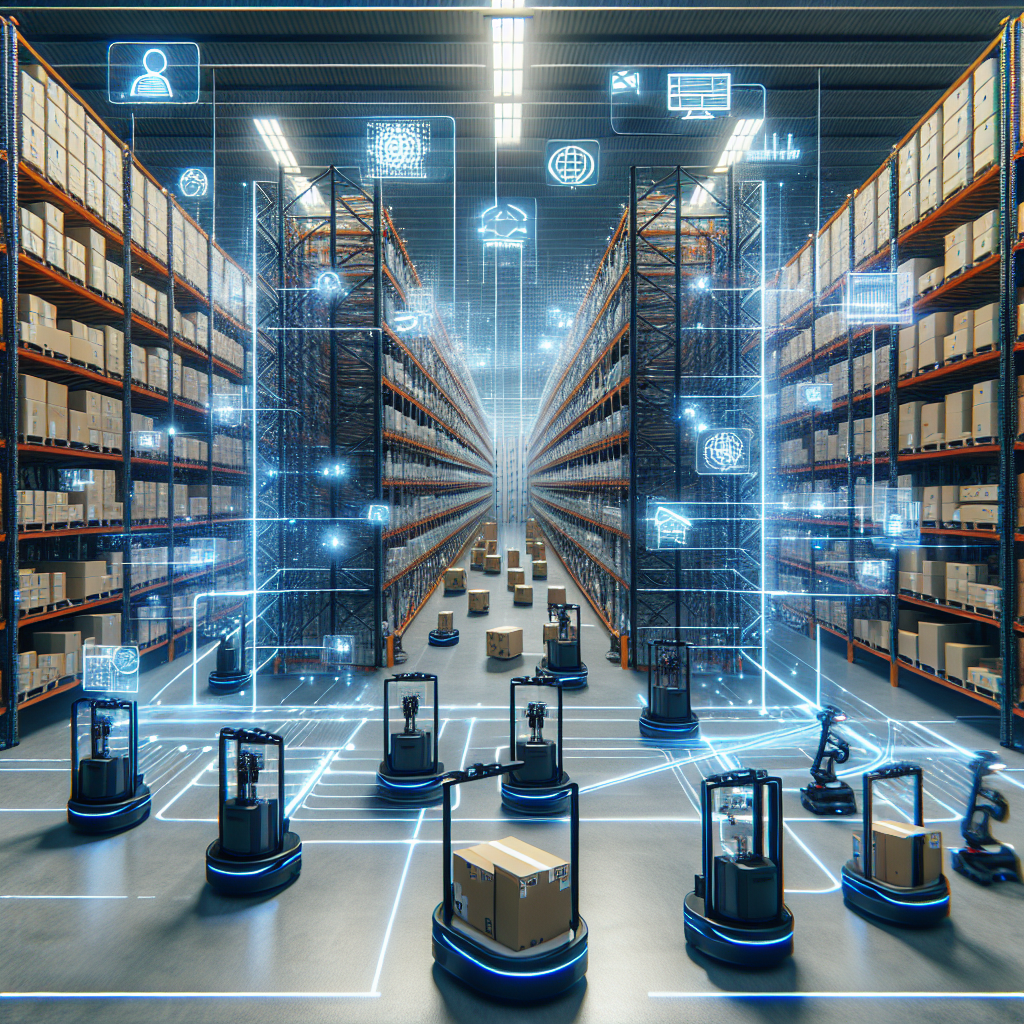
Autonomous mobile robots (AMR) are the physical backbone of zero-touch logistics environments. Unlike older automated guided vehicles (AGVs) that follow fixed tracks, AMRs use onboard sensors, cameras, and SLAM (Simultaneous Localization and Mapping) technology to navigate dynamically around obstacles and changing warehouse layouts.
Industry research from Mordor Intelligence projects the global AMR market will surpass $9 billion by 2030, driven primarily by Industry 4.0 smart factory integration demands. Major deployments include Ocado’s automated fulfillment grid and Locus Robotics’ fleet systems, both of which have cut pick times by over 30%.
AMRs communicate directly with warehouse management systems (WMS) and execution platforms, enabling real-time task reassignment based on live inventory data, workforce availability, and order priority queues — a core feature of true zero-touch orchestration.
Key Points
AMRs use SLAM technology to navigate dynamically, unlike fixed-track AGVs.
Global AMR market is projected to exceed $9 billion by 2030.
Real-time WMS integration allows AMRs to self-assign tasks without human input.
Warehouse Edge Computing: The Nervous System of Orchestrated Logistics
Warehouse edge computing processes data directly at the source — sensors, robots, conveyor systems, and RFID gates — rather than routing everything through centralized cloud servers. This architectural choice is critical because it reduces latency from hundreds of milliseconds to under 10ms, enabling robots and control systems to react in near real-time.
A practical example is Honeywell’s Intelligrated platform, which deploys edge nodes throughout distribution centers to manage sortation systems, AMR fleets, and pick-to-light arrays simultaneously. According to Gartner, by 2025, 75% of enterprise-generated data will be created and processed outside traditional centralized data centers — with industrial warehouses among the fastest-growing edge environments.
Edge computing also provides resilience. In the event of a cloud connectivity outage, on-premises edge nodes maintain full operational capability, ensuring that logistics orchestration continues uninterrupted — a mission-critical requirement for high-throughput fulfillment centers.
Key Points
Edge nodes reduce system latency to under 10ms, enabling real-time robotic control.
Gartner forecasts 75% of enterprise data will be processed at the edge by 2025.
On-premises edge architecture ensures operational continuity during cloud outages.
Industry 4.0 Smart Factory Integration: Connecting the Dots
Industry 4.0 smart factory integration is the overarching framework that binds AMRs, edge computing, IoT sensors, and AI analytics into a unified operational intelligence layer. It standardizes communication protocols — such as OPC-UA and MQTT — so that disparate systems from different vendors can exchange data seamlessly without custom middleware.
Siemens’ Digital Industries division has published case studies showing that factories adopting full Industry 4.0 integration frameworks achieve 25–35% gains in overall equipment effectiveness (OEE) within the first 18 months of deployment. These factories use digital twin technology to simulate logistics flows before physically reconfiguring warehouse layouts, dramatically reducing downtime during transitions.
For logistics operators, smart factory integration means that a purchase order placed on an e-commerce platform can automatically trigger a cascade of orchestrated actions — AMR dispatch, inventory reservation, pick-and-pack sequencing, and carrier booking — all without a single manual touchpoint from order to shipment.
Key Points
OPC-UA and MQTT protocols enable vendor-agnostic smart factory data exchange.
Full Industry 4.0 integration delivers 25–35% OEE improvements within 18 months.
Digital twins allow logistics flow simulation before physical warehouse reconfiguration.
Key Takeaways
Zero-touch logistics orchestration automates the entire warehouse workflow, reducing costs and improving order accuracy at scale.
Autonomous mobile robots (AMRs) dynamically navigate and self-assign tasks, making them essential for flexible, high-throughput fulfillment operations.
Warehouse edge computing delivers sub-10ms latency and operational resilience, forming the data infrastructure backbone of smart logistics.
Industry 4.0 smart factory integration unifies all systems under standardized protocols, enabling end-to-end process automation from order capture to shipment.
Early adopters across sectors — from e-commerce to manufacturing — are already reporting measurable ROI within 12–18 months of deployment.
Want to explore the tools and technologies powering the next generation of smart warehousing? Visit BestInSupplies.com for guides.
“`