

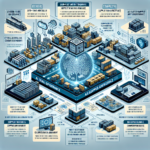





The supply chain landscape is undergoing a fundamental shift, driven by the rapid adoption of AI-powered demand forecasting and intelligent planning tools. Companies that once relied on static, spreadsheet-based models are now embracing real-time, data-driven approaches that dramatically improve accuracy, agility, and resilience.
What Is AI-Powered Demand Forecasting?
AI-powered demand forecasting uses machine learning algorithms and large datasets to predict future product demand with far greater precision than traditional methods. Unlike conventional models, AI systems continuously learn from new data — including sales history, weather patterns, economic indicators, and consumer behavior — to refine their predictions in real time.
According to McKinsey & Company, companies that deploy AI in their supply chain operations have seen forecast accuracy improve by up to 50%, reducing lost sales by 65% and lowering inventory levels by 20–50%.
Key Points:
AI models continuously learn and adapt to new market signals, improving forecast precision over time.
Companies deploying AI-powered demand forecasting report up to 50% improvement in forecast accuracy.
AI reduces reliance on static, historical-only models by incorporating real-time external data.
Continuous S&OP Planning: A Paradigm Shift in Supply Chain Management
Traditional Sales and Operations Planning (S&OP) cycles run monthly, leaving businesses vulnerable to rapid market changes in between reviews. Continuous S&OP planning replaces these rigid monthly cycles with always-on, dynamic planning processes that allow organizations to adjust their strategies daily or even hourly based on incoming data.
For example, a global consumer goods manufacturer that adopted continuous S&OP planning reduced its inventory carrying costs by 18% within the first year, while simultaneously improving service levels by 12%. By integrating AI-powered demand forecasting directly into their S&OP workflow, the company could immediately respond to demand signals rather than waiting for the next planning cycle.
Key Points:
Continuous S&OP planning replaces static monthly cycles with real-time, always-on decision-making.
Organizations report significant reductions in inventory costs and improvements in customer service levels.
Integration with AI forecasting tools amplifies the impact of continuous planning processes.
How Supply Chain Analytics Enables Smarter Decision-Making
Turning Data Into Actionable Intelligence
Modern supply chain analytics platforms aggregate data from disparate sources — ERP systems, IoT sensors, supplier portals, and market intelligence feeds — into a unified, actionable view. This holistic visibility empowers planners to detect disruptions earlier and respond with greater confidence.
Gartner research highlights that organizations with advanced supply chain analytics capabilities are 2.5 times more likely to be top performers in their industries, as measured by revenue growth and operational efficiency. The ability to convert raw data into strategic insights is now a critical competitive differentiator.
Key Points:
Advanced supply chain analytics platforms unify data from ERP, IoT, and supplier systems.
Companies with mature analytics capabilities are 2.5x more likely to outperform industry peers.
Analytics-driven visibility accelerates disruption detection and response time.
Lead Time Reduction Through AI and Continuous Planning
Compressing Cycle Times Across the Supply Chain
One of the most tangible outcomes of combining AI-powered demand forecasting with continuous S&OP planning is meaningful lead time reduction. When planners have accurate, real-time demand signals, they can proactively communicate with suppliers, adjust production schedules, and optimize transportation routes before bottlenecks develop.
A study by Deloitte found that AI-enabled supply chains achieved an average lead time reduction of 35% compared to companies using conventional planning methods. This compression translates directly into lower working capital requirements, faster time-to-market, and improved customer satisfaction scores.
Key Points:
AI-driven forecasting enables proactive supplier and production adjustments, reducing lead times by up to 35%.
Shorter lead times lower working capital requirements and accelerate time-to-market.
Continuous planning keeps lead time reduction gains sustainable rather than episodic.
Implementing AI-Powered Demand Forecasting: Best Practices
Successful implementation of AI-powered demand forecasting requires a combination of clean data infrastructure, cross-functional alignment, and a phased rollout strategy. Organizations should start by auditing their existing data quality, since AI models are only as accurate as the data they are trained on.
Leading companies also invest heavily in change management, ensuring that supply chain planners understand how to interpret and act on AI-generated recommendations rather than defaulting to manual overrides that undermine model performance. Partnering with experienced technology vendors and consulting firms can significantly accelerate the maturity curve.
Key Points:
Data quality audits are an essential first step before deploying any AI forecasting solution.
Change management and planner training are critical to sustaining AI-driven improvements.
Phased rollouts reduce implementation risk and allow iterative learning.
Key Takeaways
AI-powered demand forecasting can improve forecast accuracy by up to 50%, reducing inventory waste and lost sales simultaneously.
Continuous S&OP planning transforms supply chain agility by replacing monthly review cycles with real-time, data-driven decision-making.
Advanced supply chain analytics platforms provide the unified data visibility needed to power AI forecasting and continuous planning initiatives.
Organizations that integrate AI with continuous S&OP processes achieve lead time reductions of up to 35%, improving both cost efficiency and customer satisfaction.
Successful implementation requires strong data governance, cross-functional alignment, and ongoing change management investment.
Want to explore more strategies for optimizing your supply chain operations? Visit BestInSupplies.com for in-depth articles, expert guides, and the latest insights on demand forecasting, supply chain analytics, continuous S&OP planning, and lead time reduction strategies tailored for today’s dynamic market environment.