







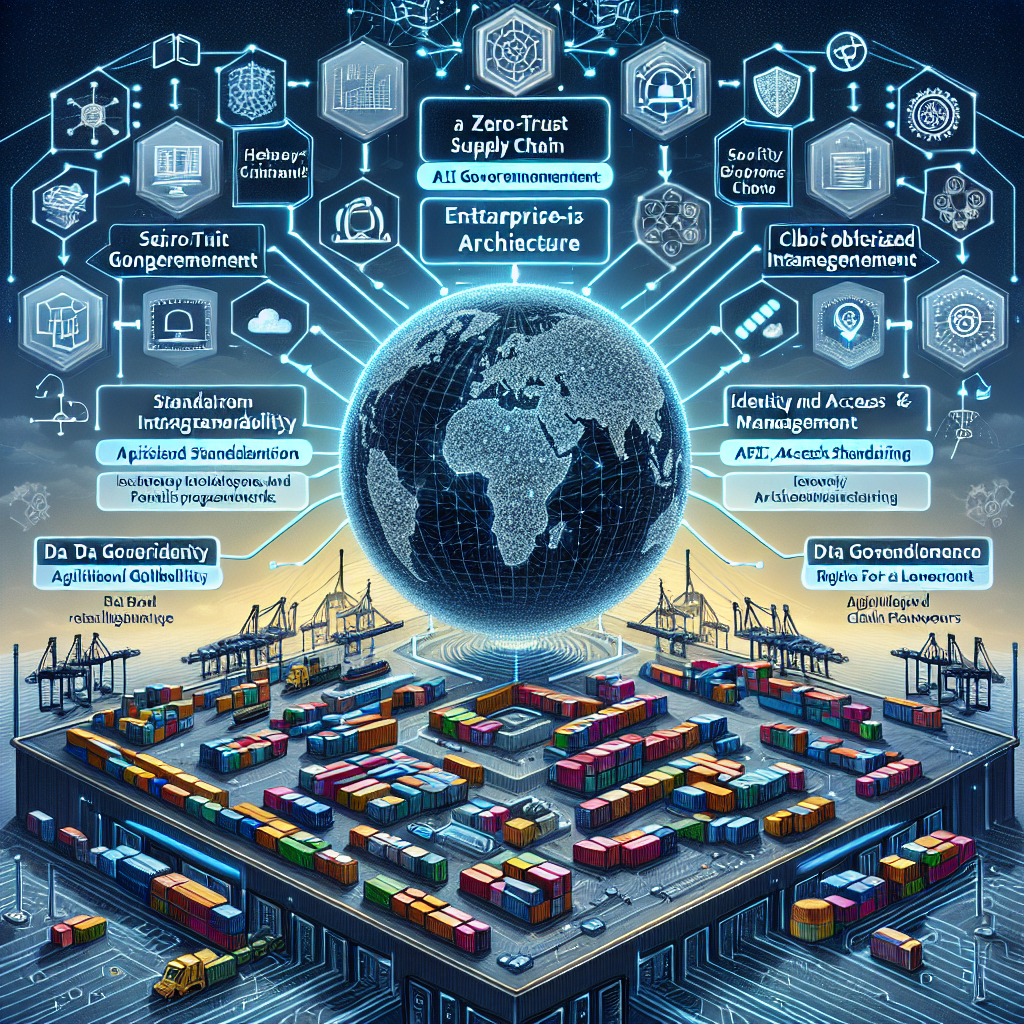
Global supply chains are under mounting pressure from regulatory complexity, cybersecurity threats, and the accelerating pace of digital transformation. Organizations that invest in resilient supply chain architecture design—anchored by strong AI governance in supply chain operations, zero-trust frameworks, and unified data standards—are positioned to outperform competitors while maintaining compliance and operational continuity. This post explores the structural pillars reshaping enterprise supply chain infrastructure today.
Why AI Governance in Supply Chain Operations Is No Longer Optional
Artificial intelligence is rapidly embedding itself into demand forecasting, supplier risk scoring, and logistics optimization—but without a structured supply chain IT governance framework, AI introduces as many risks as it resolves. According to a 2023 Gartner report, by 2026, over 75% of supply chain organizations will have deployed AI in some capacity, yet fewer than 30% have formal AI governance policies in place. This gap creates exposure to biased decision-making, regulatory violations, and loss of stakeholder trust.
Effective AI governance in supply chain environments requires clear model documentation, explainability standards, and defined accountability chains for automated decisions. For example, a global pharmaceutical distributor implementing AI-driven supplier selection must ensure its models comply with FDA traceability requirements and EU AI Act provisions—both of which demand data lineage in supply chain systems and audit trails for algorithmic outputs. Without these controls, even a well-performing model becomes a compliance liability.
Supply chain compliance frameworks must evolve to address AI-specific risks, including model drift, training data bias, and third-party AI tool integration. Organizations should establish cross-functional AI review boards that include legal, IT, and procurement stakeholders to continuously monitor deployed models. This governance layer ensures that AI-driven insights remain aligned with both business objectives and regulatory mandates.
● Formal AI governance policies are critical to managing algorithmic risk in supply chain decision-making.
● Data lineage and model explainability are foundational requirements under emerging regulations like the EU AI Act.
● Cross-functional AI review boards help bridge compliance and operational accountability gaps.
Zero-Trust Supply Chain Architecture: Securing Multi-Enterprise Networks
Traditional perimeter-based security models are inadequate for today’s multi-enterprise supply chain networks, where data flows freely across suppliers, logistics providers, and cloud platforms. Zero-trust supply chain architecture operates on the principle of “never trust, always verify,” requiring continuous authentication and authorization for every user, device, and application accessing supply chain systems. The SolarWinds breach of 2020—which compromised over 18,000 organizations through a trusted software update—illustrated exactly how legacy trust models can catastrophically fail in interconnected supply ecosystems.
Implementing zero-trust in a digital supply chain architecture involves deploying supply chain identity and access management (IAM) solutions that enforce least-privilege access, micro-segmentation, and real-time behavioral analytics. For instance, a tier-one automotive manufacturer managing 500-plus suppliers can use IAM platforms like CyberArk or Okta to ensure that each supplier only accesses the specific data sets and systems relevant to their role—nothing more. This approach also supports secure data sharing in supply chain environments without exposing sensitive pricing, inventory, or production data to unauthorized parties.
Cyber-resilience in logistics requires that zero-trust principles extend beyond IT infrastructure to operational technology (OT) systems, including warehouse management platforms and transportation management systems. As cloud supply chain architecture becomes the norm, organizations must ensure that their cloud providers adhere to zero-trust standards through contractual service-level agreements and third-party security audits. Building this layer of resilient supply chain architecture design protects not only internal operations but also the broader supplier ecosystem.
● Zero-trust architecture eliminates implicit trust assumptions that expose multi-enterprise networks to lateral cyberattacks.
● IAM solutions enable granular, role-based access control across hundreds of supplier touchpoints.
● Zero-trust must extend to OT systems and cloud environments to achieve comprehensive cyber-resilience in logistics.
Supply Chain Data Governance and Standardization as Strategic Infrastructure
Fragmented data is one of the most persistent obstacles to supply chain agility, and supply chain data governance provides the structural framework to address it. Master data management supply chain programs create a single source of truth for critical data entities—products, suppliers, locations, and contracts—ensuring that all enterprise systems operate from consistent, validated records. According to IBM, poor data quality costs organizations an average of $12.9 million annually, with supply chain errors representing a disproportionate share of that figure.
Supply chain data standardization initiatives, such as adopting GS1 global standards or ISO 8000 data quality frameworks, enable interoperability in supply chain systems across organizational and geographic boundaries. A concrete example is Walmart’s mandate that suppliers adopt Electronic Data Interchange (EDI) standards and, more recently, RFID-based item-level tracking—a move that improved inventory accuracy from 63% to 95% in pilot programs. These standardization efforts are the backbone of API-driven supply chain integration, allowing disparate enterprise resource planning (ERP), warehouse management, and transportation systems to exchange data seamlessly.
Supplier data governance extends these principles into the extended supply network, ensuring that third-party data entering the enterprise meets defined quality, security, and format requirements. Regulatory compliance in global supply chains—including mandates like the EU’s Corporate Sustainability Reporting Directive (CSRD) and the U.S. Uyghur Forced Labor Prevention Act—demands not only accurate supplier data but also verifiable supply chain auditability. Organizations that invest in robust data lineage in supply chain systems can trace every data point from origin to decision, satisfying regulatory scrutiny while reducing operational risk.
● Master data management creates the data foundation needed for reliable cross-system supply chain operations.
● GS1 and ISO standards drive interoperability and support API-driven integration across enterprise boundaries.
● Supply chain auditability and data lineage are essential for meeting global regulatory compliance requirements.
Building a Resilient Supply Chain Platform Architecture
Modern supply chain platform architecture is shifting from monolithic ERP systems to composable, API-first ecosystems that can rapidly adapt to disruption. Gartner’s “composable enterprise” model advocates for modular supply chain capabilities—procurement, logistics, demand sensing—that can be assembled and reconfigured based on business needs. This approach reduces technology lock-in and supports the kind of resilient supply chain architecture design that can absorb shocks from geopolitical events, natural disasters, or sudden demand shifts.
Risk governance frameworks in logistics are increasingly embedded directly into platform architecture, with real-time risk scoring dashboards, automated supplier compliance checks, and escalation workflows integrated into procurement and logistics platforms. For example, Resilinc and Everstream Analytics offer supply chain risk platforms that ingest news feeds, geopolitical data, and supplier financial indicators to provide predictive disruption alerts—enabling procurement teams to act before a single shipment is delayed. These platforms operationalize risk governance frameworks in logistics by making risk data actionable at the point of decision.
Enterprise supply chain architecture must also prioritize supply chain auditability and traceability as design requirements, not afterthoughts. By embedding audit logging, role-based access controls, and immutable data records into the platform layer, organizations can respond to regulatory inquiries, customer audits, and internal investigations with speed and confidence. This architectural discipline is what differentiates organizations that merely survive disruptions from those that emerge stronger.
● Composable, API-first architecture enables supply chains to adapt rapidly without costly system overhauls.
● Integrated risk governance platforms convert risk intelligence into real-time, actionable procurement decisions.
● Auditability and traceability must be foundational design requirements in enterprise supply chain architecture.
Key Takeaways
Supply chain infrastructure is being fundamentally reshaped by the convergence of AI governance, zero-trust security, and rigorous data standards. Organizations that treat these disciplines as integrated components of their enterprise supply chain architecture—rather than isolated IT projects—will build the operational resilience needed to compete in an increasingly complex global environment. Below are the critical principles to carry forward.
● Establish formal AI governance in supply chain operations to manage algorithmic risk, ensure explainability, and maintain regulatory compliance.
● Adopt zero-trust supply chain architecture and robust supply chain identity and access management to protect multi-enterprise data flows.
● Invest in master data management supply chain programs and supply chain data standardization to eliminate data fragmentation and enable interoperability.
● Embed risk governance frameworks in logistics directly into supply chain platform architecture for real-time, proactive disruption management.
● Ensure supply chain auditability and data lineage capabilities are built into system design to support regulatory compliance in global supply chains.
Ready to go deeper on the strategies reshaping supply chain infrastructure? Visit BestInSupplies.com for expert insights, practical guidance, and the latest resources on enterprise supply chain architecture, supplier data governance, and digital transformation. Explore our related content to help your organization build a supply chain that is not only efficient but genuinely resilient.