

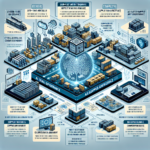





Global supply chains face mounting pressures from cyberattacks, regulatory mandates, and data fragmentation. Organizations that invest in robust enterprise supply chain architecture — anchored by AI governance, zero-trust principles, and compliance frameworks — are better positioned to deliver operational resilience and stakeholder trust. This post explores the architectural pillars driving secure, intelligent, and compliant supply chain ecosystems.
Why AI Governance in Supply Chain Can No Longer Be Optional
Artificial intelligence is rapidly reshaping demand forecasting, supplier risk scoring, and logistics optimization. However, ungoverned AI creates blind spots: biased procurement decisions, opaque model outputs, and accountability gaps that regulators are increasingly scrutinizing. AI governance in supply chain establishes the policies, oversight mechanisms, and audit trails needed to deploy AI responsibly at scale.
The EU AI Act and the US NIST AI Risk Management Framework both signal that organizations using AI in high-impact operational contexts — including supply chain — must document model lineage, monitor drift, and ensure explainability. Companies like Siemens and Unilever have already embedded AI ethics boards into their supply chain governance structures, setting an enterprise benchmark. Without similar guardrails, businesses risk regulatory penalties and reputational damage that far outweigh short-term efficiency gains.
Effective supply chain IT governance extends AI oversight into data pipelines, integration layers, and vendor-facing systems. Governance frameworks should define who owns AI models, how training data is curated, and what happens when a model underperforms — creating a closed-loop accountability structure across the supply network.
Key Points
AI governance frameworks must address model transparency, auditability, and bias mitigation across supplier and logistics systems.
Regulatory frameworks like the EU AI Act are elevating compliance stakes for AI-driven supply chain decisions.
IT governance policies should assign clear ownership for AI assets across the enterprise supply network.
Zero-Trust Supply Chain Architecture: Trust Nothing, Verify Everything
Traditional perimeter-based security is insufficient for modern multi-enterprise supply chain networks where data flows across cloud platforms, third-party APIs, and geographically dispersed partners. Zero-trust supply chain architecture operates on the principle of continuous verification — no user, device, or system is inherently trusted, regardless of network location. This model significantly reduces the attack surface across extended supply chain ecosystems.
The SolarWinds attack of 2020 demonstrated the catastrophic consequences of implicit trust in supply chain software pipelines, compromising over 18,000 organizations globally. Adopting zero-trust means implementing micro-segmentation, least-privilege access, and real-time behavioral analytics across every integration point. Supply chain identity and access management (IAM) becomes a cornerstone capability — ensuring that only verified identities with appropriate permissions can access sensitive operational or supplier data.
In a cloud supply chain architecture, zero-trust controls must extend to cloud-native workloads, container environments, and API gateways. Platforms like Microsoft Azure, AWS, and Google Cloud provide native zero-trust toolkits, but organizations must configure and govern these tools in alignment with their broader supply chain compliance framework — not rely on default settings. NIST SP 800-207 provides a vendor-neutral reference architecture for zero-trust implementation that supply chain leaders can adopt as a baseline.
Key Points
Zero-trust architecture eliminates implicit trust across all supply chain integration and access points.
Supply chain IAM controls must govern both internal users and external supplier-facing systems.
Cloud-native zero-trust tools require deliberate configuration aligned with compliance requirements.
Supply Chain Data Governance and Master Data Management
Data is the operational currency of the modern supply chain, but inconsistent, siloed, or ungoverned data erodes decision quality and creates compliance risk. Supply chain data governance defines the standards, stewardship roles, and lifecycle policies that ensure data is accurate, consistent, and accessible across the enterprise. Without it, even the most sophisticated analytics platforms yield unreliable outputs.
Master data management (MDM) in supply chain addresses the root cause of data fragmentation by creating a single, authoritative source of truth for critical entities — suppliers, products, locations, and contracts. According to Gartner, poor data quality costs organizations an average of $12.9 million annually, a figure that scales dramatically in complex, global supply environments. Leading manufacturers like Procter & Gamble and Johnson & Johnson have invested heavily in MDM platforms to synchronize supplier data governance across hundreds of trading partners.
Supply chain data standardization enables seamless interoperability in supply chain systems, allowing disparate ERP, WMS, and TMS platforms to exchange data without costly custom integrations. Standards like GS1, EDIFACT, and OpenAPI specifications provide a common language for API-driven supply chain integration, reducing integration latency and error rates. Data stewardship teams should enforce these standards across onboarding workflows for new suppliers and technology vendors alike.
Key Points
MDM creates a unified, governed source of truth for supplier, product, and location data across the enterprise.
Data standardization using GS1 and OpenAPI frameworks accelerates interoperability across supply chain systems.
Poor data governance directly increases operational costs and undermines AI and analytics investments.
Data Lineage, Auditability, and Regulatory Compliance in Global Supply Chains
Data lineage in supply chain systems tracks the origin, transformation, and movement of data across every touchpoint — from raw material sourcing to final delivery. This visibility is essential for troubleshooting data quality issues, satisfying audit requests, and demonstrating compliance with regulations such as GDPR, DORA, and the Uyghur Forced Labor Prevention Act (UFLPA). Without lineage tools, organizations cannot credibly answer regulators’ questions about how specific data was collected, processed, or shared.
Supply chain auditability extends beyond data lineage to encompass process traceability, supplier certifications, and transaction records. Blockchain-enabled platforms like IBM Food Trust and TradeLens (now succeeded by successor initiatives) have demonstrated how distributed ledger technology can create immutable, auditable records across multi-enterprise supply chain networks. These capabilities are increasingly demanded by retail giants and government contractors as contractual prerequisites. For practical guidance, GS1’s traceability standards offer a globally recognized framework for implementing end-to-end supply chain visibility.
Regulatory compliance in global supply chains is growing more complex, with requirements spanning environmental disclosures (SEC Climate Rules, CSRD), forced labor prohibitions, and cybersecurity mandates (NIS2, CMMC). Risk governance frameworks in logistics must be dynamic — continuously updated as regulations evolve and supplier risk profiles change. Organizations should integrate compliance monitoring directly into their supply chain platform architecture rather than treating it as a periodic, manual exercise.
Key Points
Data lineage tools provide the traceability required by regulators under GDPR, UFLPA, and sector-specific mandates.
Immutable audit trails — including blockchain-based records — are becoming contractual requirements in enterprise supply networks.
Risk governance frameworks must be embedded in platform architecture, not managed as standalone compliance activities.