

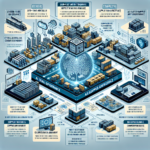





Agentic AI in supply chain management is no longer a concept confined to research labs — it is actively reshaping how companies source, move, and deliver goods at scale. Unlike traditional automation, autonomous agents can perceive their environment, reason through complex trade-offs, and execute multi-step procurement and logistics decisions without constant human oversight.
From AI-powered demand forecasting to real-time rerouting of freight, the convergence of large language models, IoT sensor networks, and cognitive automation is creating supply chains that are genuinely self-optimizing. This post explores how these technologies work together — and what they mean for procurement leaders, logistics managers, and operations teams right now.
What Is Agentic AI — and Why Does It Matter for Supply Chains?
Agentic AI refers to systems that combine perception, planning, memory, and action into a continuous decision-making loop. In a supply chain context, an autonomous agent might monitor supplier lead times, detect an impending shortage, issue a purchase order to an approved alternate vendor, and update the ERP — all without a human initiating each step.
According to Gartner, by 2028 at least 15% of day-to-day business decisions will be made autonomously by AI agents, up from near zero in 2024. For supply chain professionals, this shift represents both a competitive advantage and an operational imperative, particularly as global disruptions continue to expose the fragility of static, plan-then-execute workflows.
Key Points
- Agentic AI operates in closed-loop cycles — sense, plan, act, learn — enabling real-time response to supply disruptions.
- Gartner projects autonomous AI decision-making to grow 15x in enterprise settings by 2028.
- Supply chains are an ideal proving ground because they involve structured data, repeatable workflows, and measurable KPIs.
Autonomous Procurement Agents: Redefining Sourcing from the Ground Up
Autonomous procurement agents are purpose-built AI systems that handle sourcing tasks end-to-end — from RFQ generation and supplier evaluation to contract negotiation and order placement. Companies like Coupa and Jaggaer are already embedding agentic capabilities into their platforms, enabling procurement teams to shift focus from transactional work to strategic supplier relationships.
A concrete example: A global electronics manufacturer deploying an autonomous procurement agent can automatically compare 40+ supplier bids, score them against price, lead time, ESG compliance, and geopolitical risk, then recommend — or directly execute — the optimal award. This process that once took a procurement analyst three to five days can be completed in under two hours. For organizations managing tens of thousands of SKUs, that compression of cycle time translates directly to working capital efficiency and reduced stockout risk.
Critically, these agents integrate with enterprise procurement ecosystems and external data sources such as commodity indices, weather APIs, and customs databases, creating a live, context-aware sourcing engine rather than a static rule-based bot. This is the hallmark of true cognitive supply chain automation.
Key Points
- Autonomous procurement agents compress multi-day sourcing cycles into hours by scoring bids across price, lead time, risk, and ESG criteria simultaneously.
- Platforms like Coupa and Jaggaer are actively embedding agentic AI into procurement workflows.
- Integration with live external data sources elevates these agents beyond traditional RPA into genuine cognitive automation.
AI-Powered Demand Forecasting and Continuous S&OP Planning
Traditional Sales & Operations Planning (S&OP) operates on monthly or weekly cycles, making it structurally unable to respond to sudden demand shocks — as the COVID-19 pandemic and the 2021 semiconductor shortage made painfully clear. AI-powered demand forecasting combined with continuous S&OP planning fundamentally changes this dynamic by enabling organizations to re-plan in near real time.
Modern AI forecasting models ingest point-of-sale data, social sentiment signals, macroeconomic indicators, and even weather pattern data to generate probabilistic demand scenarios. According to McKinsey, companies using AI-enhanced demand forecasting have reduced forecast errors by 20–50% and cut inventory levels by 20–30% while simultaneously improving service levels. When these forecasts feed directly into an agentic S&OP engine, production schedules, supplier releases, and logistics capacity can all be adjusted automatically — closing the loop between demand signal and supply response.
Supply chain digital twins amplify this capability further. By creating a virtual replica of the end-to-end supply network, organizations can simulate the downstream impact of a demand spike, a port closure, or a supplier failure before committing real resources. Companies such as Siemens and Unilever have publicly documented using digital twin technology to reduce planning cycle times by up to 60%, demonstrating the tangible operational value of marrying simulation with agentic decision-making. Learn more about how digital twins are being applied across industries at Gartner’s Supply Chain Digital Twin resource center.
Key Points
- AI-powered demand forecasting reduces forecast errors by 20–50% and inventory levels by 20–30%, per McKinsey research.
- Continuous S&OP planning replaces static monthly cycles with near-real-time re-planning driven by live demand signals.
- Supply chain digital twins allow organizations to stress-test supply networks virtually before making costly physical commitments.
Generative AI for Logistics: From Route Optimization to Carrier Negotiations
Generative AI for logistics extends well beyond text summarization — it is being applied to generate optimal routing configurations, draft carrier contracts, produce customs documentation, and synthesize exception reports that would otherwise consume hours of analyst time. Companies like FedEx and DHL have begun integrating generative AI into their logistics control towers to provide real-time narrative summaries of freight exceptions alongside autonomous rerouting recommendations.
On the last-mile side, generative AI models trained on historical delivery data, traffic patterns, and customer preference signals can dynamically generate new route plans within seconds of a disruption — whether a road closure, a sudden surge in same-day orders, or a vehicle breakdown. This capability, when combined with IoT for predictive maintenance for fleet vehicles, creates a logistics operation that is simultaneously more resilient and more cost-efficient. IoT sensors monitoring engine health, tire pressure, and fuel consumption can trigger predictive maintenance alerts before a breakdown occurs, reducing unplanned downtime that McKinsey estimates costs transport companies between 5–8% of annual revenue.
Explore our coverage of AI-driven logistics innovations at BestInSupplies.com for deeper dives into how carriers and shippers are deploying these capabilities today.
Key Points
- Generative AI for logistics automates route generation, contract drafting, and exception reporting in real time.
- IoT-enabled predictive maintenance for fleet assets reduces unplanned downtime, which costs transport companies up to 8% of annual revenue.
- Leading logistics providers including FedEx and DHL are actively integrating generative AI into their operational control towers.
Cognitive Supply Chain Automation and the Future of Human-Agent Collaboration
Cognitive supply chain automation does not mean the elimination of human judgment — it means elevating where that judgment is applied. Agentic AI handles high-frequency, data-intensive tasks such as purchase order management, shipment tracking, and invoice reconciliation, while human experts focus on strategic supplier development, risk governance, and exception escalation requiring contextual or ethical reasoning.
The most successful deployments share a common design principle: human-in-the-loop oversight for decisions above a defined risk threshold, with full autonomous execution below it. For example, an agent might autonomously approve all purchase orders under $10,000 with approved suppliers but escalate any order involving a new supplier, a sanctioned country, or an unusual price variance to a human reviewer. This tiered model preserves operational speed while maintaining appropriate governance — a balance that is essential as regulatory scrutiny of AI in enterprise processes increases globally.
Organizations that have adopted this model report significant gains. A 2023 Deloitte survey found that companies with mature AI in supply chain management programs achieved 2.3x higher perfect order rates and 19% lower logistics costs compared to peers still relying on legacy planning systems. The evidence increasingly points to cognitive automation not as a future aspiration but as a present-tense competitive necessity. For additional benchmarks and vendor comparisons, visit the McKinsey Operations Insights hub.
Key Points
- Cognitive supply chain automation elevates human roles to strategic oversight while agents manage high-frequency operational tasks.
- Tiered human-in-the-loop governance frameworks balance speed with appropriate risk controls.
- Deloitte research shows mature AI supply chain programs deliver 2.3x higher perfect order rates and 19% lower logistics costs.