





What Is Agentic AI and Why Supply Chain Pros Should Care
The supply chain world is going through one of its biggest shake-ups in decades, and this time it’s not just about faster shipping or smarter warehouses. Agentic AI in supply chain operations is changing how decisions get made — moving from human-triggered automation to systems that think, act, and adapt on their own. If you’re in procurement, logistics, or planning, this shift is already showing up in the tools your vendors are pitching and the platforms your competitors are adopting.
Unlike traditional AI that waits for a prompt, agentic AI systems operate with goals, take sequences of actions, and course-correct without needing a human in the loop for every step. Think of it as the difference between a calculator and a junior analyst who never sleeps.
The stakes are real. According to Gartner, by the mid-2020s, over 15% of day-to-day work decisions in supply chain will be made autonomously by AI agents — a figure that would have seemed outrageous just a few years ago.
● Agentic AI acts on goals rather than just responding to commands
● It’s designed to handle multi-step workflows with minimal human oversight
● Supply chain is one of the fastest-adopting sectors for this technology
Autonomous Procurement Agents: The End of Manual PO Management?
One of the clearest early wins for AI in supply chain management is in procurement. Autonomous procurement agents are now capable of monitoring inventory levels, identifying shortfalls, evaluating supplier options, negotiating within pre-set parameters, and issuing purchase orders — all without a buyer clicking a single button. Companies like Coupa and Jaggaer have already embedded agent-like capabilities into their platforms, automating routine buying tasks that used to eat up hours of a procurement team’s week.
A concrete example: a global electronics manufacturer piloting autonomous procurement agents reported a 40% reduction in cycle time for indirect procurement and a 22% improvement in contract compliance, simply because the AI consistently applied sourcing rules without exceptions or fatigue. That kind of consistency is hard for human teams to match at scale.
Of course, autonomous procurement doesn’t mean procurement teams disappear. It means they stop chasing approvals and start focusing on strategic supplier relationships, risk analysis, and contract innovation — the stuff that actually moves the needle. For a deeper look at how procurement technology is evolving, check out our coverage at BestInSupplies.com.
● Autonomous agents can manage the full procure-to-pay cycle for routine purchases
● Early adopters report significant gains in cycle time and compliance
● Human buyers shift toward strategic, relationship-driven work
AI-Powered Demand Forecasting: Getting Ahead of the Bullwhip
From Statistical Models to Cognitive Demand Sensing
Traditional demand forecasting relied on historical sales data and seasonal patterns — useful, but notoriously slow to pick up on real-world signals like a viral product review, a port closure, or a sudden weather event. AI-powered demand forecasting changes that by ingesting dozens of external data streams in real time: social sentiment, macroeconomic indicators, competitor pricing, even satellite imagery of retail parking lots. The result is a forecast that updates continuously rather than monthly.
Cognitive supply chain automation platforms like o9 Solutions and Blue Yonder have demonstrated forecast accuracy improvements of 20–35% over traditional methods in documented case studies, particularly in consumer goods and retail verticals where demand volatility is high. That accuracy gain directly translates to lower safety stock requirements and fewer costly stockouts.
What makes this genuinely different from older machine learning forecasting is the reasoning layer. These systems don’t just predict — they explain why demand is expected to shift and recommend actions, which makes it far easier for planners to trust and act on the output. You can read more about how McKinsey frames AI’s role in supply chain decision-making for additional context.
● Modern AI forecasting pulls from dozens of real-time external signals
● Documented accuracy improvements range from 20–35% over legacy methods
● Explainability features help planners trust and act on AI recommendations
Generative AI for Logistics: More Than Just Chatbots
When most people hear “generative AI,” they think of chatbots and content creation. But generative AI for logistics is carving out a genuinely practical niche — generating dynamic routing plans, drafting carrier contracts, creating exception reports in plain language, and even simulating disruption scenarios for risk planning. FedEx and DHL have both publicly discussed using generative AI layers on top of their existing logistics platforms to speed up exception handling and customer communication.
One particularly interesting application is using generative AI to synthesize outputs from supply chain digital twins. A digital twin gives you a real-time virtual replica of your physical network; generative AI can then narrate what’s happening, simulate “what if” scenarios at speed, and suggest corrective actions in language that an operations manager can actually use without needing a data scientist to translate.
The combination of digital twins and generative AI is starting to look like the operations control room of the future — one where the system surfaces the right information, in the right format, at the right moment. Gartner has outlined how digital twins and AI convergence are reshaping supply chain visibility for enterprises of all sizes.
● Generative AI adds a natural language layer on top of complex logistics data
● It pairs powerfully with supply chain digital twins for scenario planning
● Major carriers are already deploying it for exception handling and communication
Continuous S&OP Planning Powered by Always-On AI
Moving Beyond the Monthly S&OP Meeting
Sales and Operations Planning has traditionally been a monthly ritual — a cross-functional meeting where teams align on a single demand and supply plan. The problem is that the world doesn’t operate on a monthly cadence. Disruptions, demand swings, and supply constraints happen daily, and the traditional S&OP cycle simply can’t keep up. Continuous S&OP planning, enabled by agentic AI, replaces the static monthly snapshot with a living plan that adjusts as conditions change.
Platforms like Anaplan and SAP Integrated Business Planning are building agent-based orchestration into their S&OP modules, allowing financial, commercial, and supply plans to reconcile automatically when key assumptions change. The human team still sets guardrails and makes high-stakes calls, but the AI handles the constant re-balancing that used to require hours of analyst work.
The business case is compelling. A CPG company that shifted to a continuous planning model with AI orchestration reported a 30% reduction in planning cycle time and a meaningful improvement in on-shelf availability — two metrics that directly impact revenue and customer satisfaction. For more on planning technology trends, visit BestInSupplies.com.
● Continuous S&OP replaces the monthly cycle with real-time plan updates
● AI agents handle routine rebalancing while humans focus on exceptions
● Early adopters report 30%+ reductions in planning cycle time
Predictive Maintenance for Fleet and IoT-Driven Supply Chain Resilience
Fleet downtime is one of those costs that’s easy to overlook until it hits — and then it hits hard. Predictive maintenance for fleet assets, powered by IoT sensor data and machine learning, is giving logistics operators the ability to catch equipment failures before they happen. Sensors on trucks, forklifts, and conveyor systems continuously stream data on temperature, vibration, fuel consumption, and component wear, feeding AI models that flag anomalies well before a breakdown occurs.
Companies like Caterpillar and Volvo Trucks have invested heavily in connected fleet platforms, reporting that predictive maintenance can reduce unplanned downtime by up to 50% and extend asset life by 20–25%. In a tight-margin logistics environment, those numbers are transformational. IoT for supply chain resilience isn’t just about tracking shipments anymore — it’s about keeping the physical infrastructure running reliably at every node in the network.
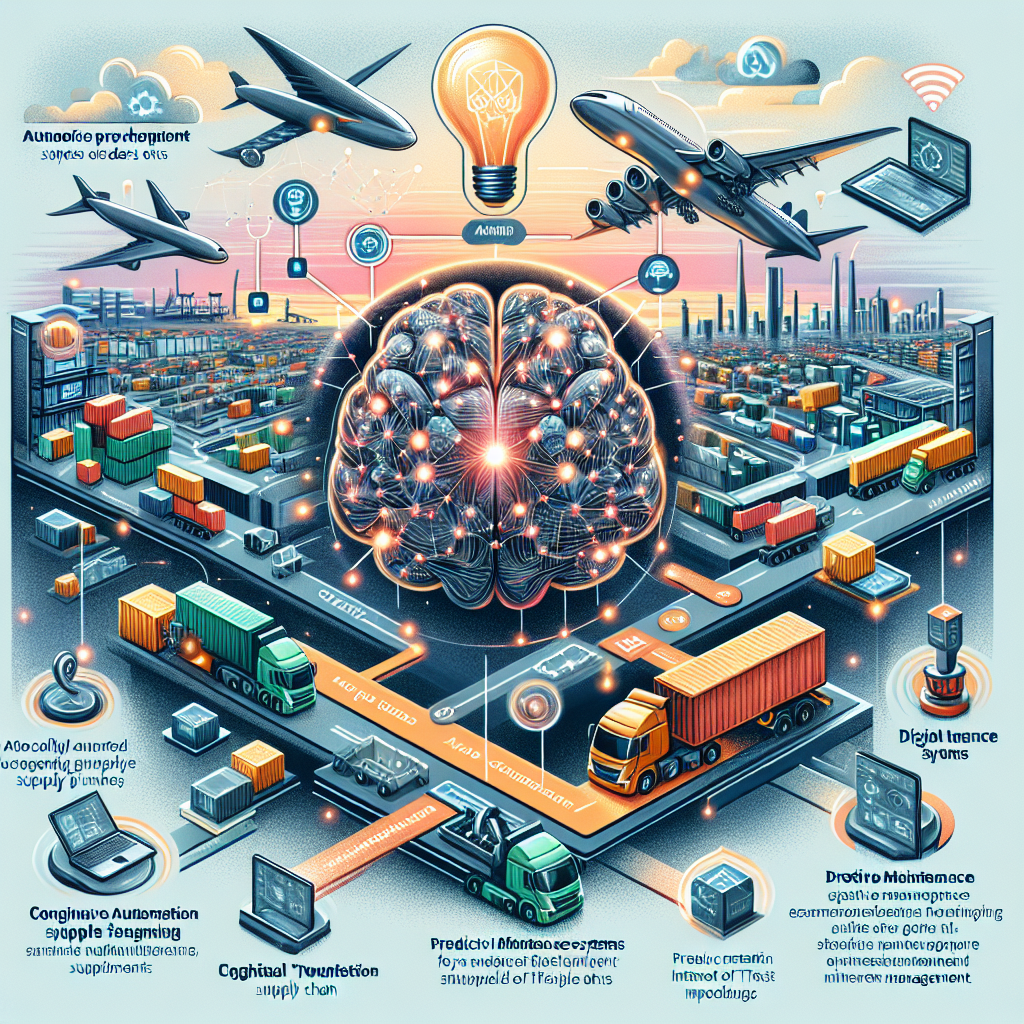
The broader vision here is a fully instrumented supply chain where every asset, from a refrigerated trailer to a warehouse conveyor belt, is a data-generating endpoint feeding into a central intelligence layer. When that data flows into a cognitive supply chain automation platform, the system can proactively reroute, reschedule, and reallocate resources in response to real-world conditions — without waiting for a human to notice the problem first.
● IoT sensors enable continuous health monitoring of fleet and warehouse assets
● Predictive maintenance can cut unplanned downtime by up to 50%
● Fully instrumented networks feed AI platforms for proactive decision-making
Key Takeaways
Agentic AI is no longer a future concept — it’s actively reshaping how supply chains plan, buy, move, and maintain. From autonomous procurement agents handling routine POs to continuous S&OP planning that never sleeps, the technology is moving fast and the early adopters are already seeing measurable returns.