





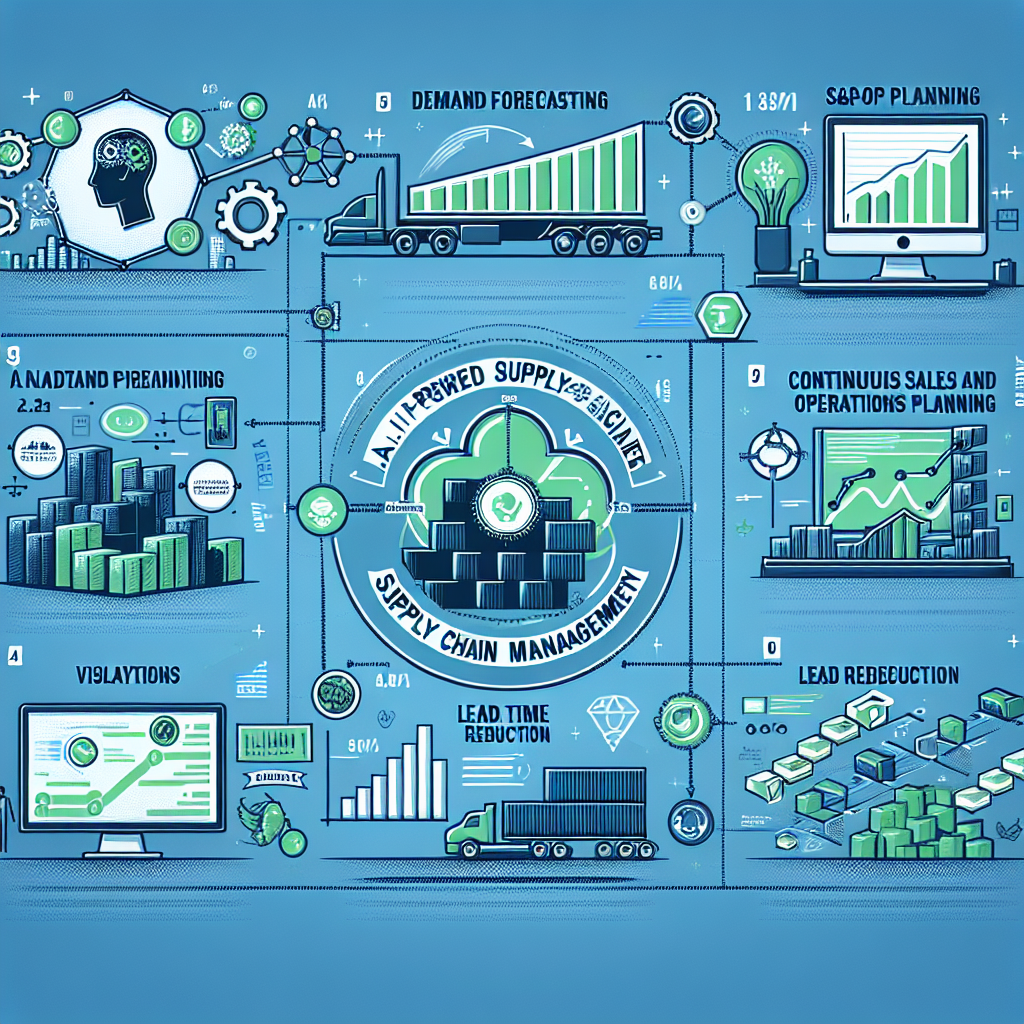
Supply chains have always been a balancing act, but the rules of the game are changing fast. Thanks to advances in AI-powered demand forecasting and continuous S&OP planning, businesses are moving away from gut-feel decisions and static spreadsheets toward smarter, data-driven strategies that actually keep up with real-world volatility.
What Is AI-Powered Demand Forecasting?
At its core, AI-powered demand forecasting uses machine learning algorithms and large datasets to predict future customer demand with far greater accuracy than traditional methods. Instead of relying on historical averages or seasonal patterns alone, AI models can factor in hundreds of variables simultaneously — things like weather events, social media trends, and supplier lead times.
Companies like Amazon and Walmart have been using AI-driven forecasting for years, reportedly reducing forecast errors by up to 50% compared to conventional statistical models. For mid-sized businesses, cloud-based AI forecasting tools are now making that same capability accessible without the need for a massive data science team.
How Machine Learning Changes the Forecasting Game
Traditional forecasting tools are largely backward-looking, meaning they extrapolate trends from the past. Machine learning models, by contrast, are continuously retrained on new data, so they adapt in near real-time as market conditions shift.
This dynamic approach is especially valuable during disruptions — think sudden shifts in consumer behavior or unexpected supplier constraints — where static models would simply fall flat. The result is a more resilient, responsive supply chain that can pivot quickly without the usual firefighting.
● AI forecasting reduces forecast error by up to 50% compared to traditional models
● Machine learning models continuously retrain on fresh data for real-time adaptability
● Cloud-based tools are making AI forecasting accessible to businesses of all sizes
Continuous S&OP Planning: Moving Beyond the Monthly Cycle
Traditional Sales and Operations Planning (S&OP) typically operates on a monthly review cycle, which feels almost laughably slow in today’s fast-moving markets. Continuous S&OP planning replaces that static cadence with an always-on process that integrates live data streams, cross-functional collaboration, and automated decision triggers.
According to Gartner, organizations that adopt continuous planning capabilities report up to a 20% improvement in forecast accuracy and significantly faster response times to market changes. Rather than waiting until the end of the month to identify a problem, teams are alerted immediately and can course-correct before issues cascade into costly disruptions. You can learn more about Gartner’s supply chain research at Gartner’s Supply Chain Resource Hub.
Integrating Demand Forecasting Into the S&OP Workflow
One of the biggest advantages of pairing demand forecasting with continuous S&OP planning is the ability to align procurement, production, and logistics in one synchronized flow. When a demand signal changes — say, a sudden spike in orders for a particular product — the S&OP process automatically triggers adjustments across the entire supply chain.
This kind of tight integration also means that finance, sales, and operations teams are always working from the same set of numbers, which dramatically reduces the internal friction that slows decision-making. Check out our article on supply chain collaboration strategies at BestInSupplies.com for more on breaking down those silos.
● Continuous S&OP replaces slow monthly cycles with always-on, real-time planning
● Gartner reports up to 20% forecast accuracy improvement with continuous planning
● Cross-functional alignment reduces internal friction and speeds up decision-making
The Impact on Supply Chain Analytics
The marriage of AI forecasting and continuous planning has turbo-charged supply chain analytics in ways that were simply not possible with legacy systems. Modern analytics platforms can now deliver end-to-end visibility — from raw material availability all the way to last-mile delivery — in a single dashboard.
For example, companies using platforms like Blue Yonder or o9 Solutions are able to run thousands of scenario simulations simultaneously, helping planners evaluate the impact of different decisions before committing to them. This kind of prescriptive analytics capability turns supply chain teams from reactive problem-solvers into proactive strategists. Explore how o9 Solutions is advancing supply chain analytics with their integrated planning platform.
Turning Data Into Actionable Insights
Raw data is only useful if it leads to better decisions, and that’s where the analytical layer becomes critical. AI-powered supply chain analytics doesn’t just surface what’s happening — it recommends what to do next, and even automates routine decisions like reorder triggering or safety stock adjustments.
This shift from descriptive to prescriptive analytics is one of the most significant transformations in modern supply chain management, and businesses that embrace it are seeing measurable improvements across cost, service level, and agility. For a deeper dive, visit our post on the best supply chain analytics tools available today at BestInSupplies.com.
● End-to-end visibility platforms consolidate supply chain data into one dashboard
● Prescriptive analytics recommends and even automates key supply chain decisions
● Scenario simulation helps planners evaluate outcomes before committing to a course of action
Lead Time Reduction Through Smarter Planning
One of the most tangible benefits of AI-powered planning is lead time reduction — the ability to compress the time between placing an order and receiving goods. When forecasting is accurate and planning is continuous, procurement teams can order earlier, more precisely, and with less safety stock padding.
A concrete example: a major consumer electronics manufacturer that implemented AI-driven demand forecasting reported a 30% reduction in average lead times within the first year, largely because better demand signals allowed suppliers to plan their own production schedules more efficiently. That kind of ripple effect up and down the supply chain is what makes AI-powered forecasting such a game-changer.
How Continuous Planning Supports Lead Time Reduction
Lead time reduction isn’t just about moving faster — it’s about eliminating the delays caused by poor information and misaligned planning cycles. When S&OP runs continuously and demand signals update in real time, there’s no lag between what the market is telling you and what your procurement team is acting on.
This alignment naturally compresses lead times because decisions happen closer to the moment they’re needed, with better information backing them up. Businesses that pair lead time reduction efforts with continuous S&OP planning consistently outperform peers on both cost efficiency and customer satisfaction metrics.
● AI forecasting enables earlier, more precise procurement that naturally shortens lead times
● Real-time demand signals eliminate the information lag that causes planning delays
● Better supplier alignment driven by accurate forecasts creates compounding lead time benefits
Key Takeaways
AI-powered demand forecasting and continuous S&OP planning are no longer futuristic concepts — they’re practical tools that are delivering measurable results for supply chains of all sizes. Here’s a quick summary of the most important points to carry with you:
● AI-powered demand forecasting can reduce forecast errors by up to 50%, giving businesses a massive edge in planning accuracy
● Continuous S&OP planning replaces slow, outdated monthly cycles with always-on, real-time decision-making
● Integrated supply chain analytics transforms raw data into prescriptive, actionable insights
● Lead time reduction is one of the most immediate and measurable benefits of smarter, AI-driven planning
● Businesses that invest in these capabilities consistently outperform competitors on cost, agility, and customer service
Want to keep exploring how technology is reshaping modern supply chains? Head over to BestInSupplies.com for more in-depth articles, tool comparisons, and expert insights on demand forecasting, supply chain analytics, and everything in between. There’s a lot more to discover!