

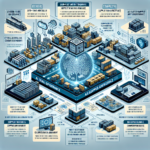





Global supply chains are under mounting pressure from cyber threats, regulatory complexity, and fragmented data ecosystems. Organizations that invest in AI governance in supply chain operations, zero-trust supply chain architecture, and robust supply chain data standardization are emerging as the leaders in operational resilience. This post explores how forward-thinking enterprises are redesigning their infrastructure to meet the demands of a fast-evolving digital landscape.
Why AI Governance in Supply Chain Is No Longer Optional
Artificial intelligence is rapidly reshaping how supply chains forecast demand, manage inventory, and detect anomalies — but without a structured AI governance in supply chain framework, these capabilities introduce significant risk. According to a 2023 Gartner report, by 2026, more than 75% of organizations will experience AI-related failures due to inadequate governance practices, many of which will directly impact supply chain continuity.
Effective supply chain IT governance requires clearly defined policies for AI model validation, bias auditing, and performance monitoring at every node of the supply network. For example, a global automotive manufacturer implementing AI-driven supplier risk scoring must ensure that the underlying model is transparent, explainable, and aligned with both internal compliance standards and external regulatory requirements such as the EU AI Act.
Integrating AI governance into your broader supply chain compliance framework also means establishing cross-functional oversight committees that include IT, legal, procurement, and operations. This collaborative approach ensures that AI tools are deployed responsibly and that accountability is clearly assigned when automated decisions affect supplier relationships or logistics outcomes.
● Establish documented AI model validation and audit cycles within your supply chain governance structure.
● Align AI governance policies with emerging regulatory mandates such as the EU AI Act and ISO/IEC 42001.
● Embed cross-functional oversight to ensure AI decisions remain explainable and accountable.
Zero-Trust Supply Chain Architecture: A New Security Imperative
Rethinking Trust in Multi-Enterprise Supply Chain Networks
Traditional perimeter-based security models are fundamentally inadequate for today’s multi-enterprise supply chain networks, where data flows across dozens of third-party vendors, logistics providers, and cloud platforms. Zero-trust supply chain architecture operates on the principle of “never trust, always verify,” requiring continuous authentication and authorization at every access point regardless of whether the user or device is inside or outside the corporate network.
A practical implementation of zero-trust in logistics involves deploying supply chain identity and access management (IAM) solutions that enforce least-privilege access across all supplier portals, ERP integrations, and warehouse management systems. Companies like Maersk, following the devastating NotPetya cyberattack in 2017 that cost an estimated $300 million, have since invested heavily in zero-trust principles to prevent lateral movement across their global networks.
Building cyber-resilience in logistics through zero-trust also demands continuous network monitoring, micro-segmentation of supply chain applications, and real-time anomaly detection. When integrated with a cloud supply chain architecture, zero-trust controls can dynamically scale to protect data exchanged across globally distributed nodes without sacrificing operational speed.
● Deploy identity and access management solutions that enforce least-privilege principles across all supply chain endpoints.
● Implement micro-segmentation to contain potential breaches within isolated supply chain system layers.
● Treat cyber-resilience as a continuous operational discipline, not a one-time IT project.
Secure Data Sharing in Supply Chain Ecosystems
Secure data sharing in supply chain environments requires more than encryption — it demands governance policies that define who can access what data, under what conditions, and with what level of auditability. Federated identity models and tokenized data exchanges are increasingly being adopted by large retailers and manufacturers to enable partner collaboration without exposing sensitive commercial data.
Technologies such as blockchain-anchored data vaults and API gateways with OAuth 2.0 protocols are enabling API-driven supply chain integration while maintaining granular access controls. These architectures support real-time data exchange between trading partners while preserving data sovereignty — a critical consideration for organizations operating under GDPR, CCPA, or sector-specific regulations like DSCSA for pharmaceuticals.
● Adopt tokenized data exchange and federated identity models to enable secure partner collaboration.
● Use API gateways with modern authentication protocols to govern third-party data access.
● Ensure all data sharing agreements are backed by enforceable governance policies and audit trails.
Supply Chain Data Governance and Master Data Management
The Role of Master Data Management in Supply Chain Accuracy
Master data management supply chain programs are foundational to eliminating the data inconsistencies that erode forecast accuracy, inflate procurement costs, and create compliance blind spots. A 2022 IDC study found that poor data quality costs organizations an average of $12.9 million annually, with supply chain operations among the most impacted functions due to the sheer volume of product, supplier, and logistics data they manage.
Effective supplier data governance begins with establishing a single, authoritative source of truth for supplier records — including financial data, certifications, risk ratings, and contractual terms. Organizations like Unilever have implemented centralized supplier master data platforms that synchronize across procurement, finance, and logistics systems, dramatically reducing onboarding times and improving audit readiness.
● Build a centralized supplier master data repository that serves as a single source of truth across all business units.
● Enforce data quality rules at the point of entry to prevent downstream errors in procurement and logistics.
● Regularly audit supplier records to ensure compliance certifications and risk ratings remain current.
Data Lineage and Auditability in Enterprise Supply Chain Architecture
Data lineage in supply chain systems provides a traceable record of how data originates, transforms, and flows across the enterprise — an essential capability for both operational integrity and regulatory compliance. In highly regulated industries such as aerospace, food and beverage, and pharmaceuticals, the ability to trace a product ingredient or component back to its source in seconds can mean the difference between a controlled recall and a catastrophic brand failure.
Supply chain auditability is increasingly mandated by frameworks such as the SEC’s climate disclosure rules, the EU Corporate Sustainability Reporting Directive (CSRD), and the U.S. Uyghur Forced Labor Prevention Act, all of which require demonstrable traceability across supply chain tiers. Embedding data lineage tools into your enterprise supply chain architecture ensures that compliance evidence is generated automatically and stored in tamper-evident formats accessible to auditors on demand.
● Implement data lineage tracking tools that automatically document data origin, transformation, and movement across systems.
● Design your enterprise architecture to generate audit-ready compliance evidence as a byproduct of normal operations.
● Align lineage and auditability capabilities with specific regulatory mandates relevant to your industry and geography.
Interoperability and Standards: The Foundation of Digital Supply Chain Architecture
Interoperability in supply chain systems is the connective tissue that enables diverse platforms, partners, and geographies to function as a unified operational network. Without common data standards and integration protocols, even the most sophisticated digital investments become isolated islands of capability that fail to deliver cross-enterprise value.
Supply chain data standardization initiatives — such as GS1 standards for product identification, EDI protocols for transaction messaging, and EPCIS for event data sharing — provide the common language that makes interoperability in supply chain systems achievable at scale. For instance, GS1’s Global Data Synchronization Network (GDSN) currently connects over 60,000 trading partners in more than 150 countries, enabling near-real-time product data alignment across retail and consumer goods supply chains.
A well-designed supply chain platform architecture leverages open APIs, microservices, and event-driven integration patterns to connect legacy ERP systems with modern cloud-native applications without requiring full system replacement. This approach, often referred to as composable architecture, allows organizations to adopt best-in-class capabilities incrementally while maintaining data consistency and governance across all connected systems.
● Adopt globally recognized data standards such as GS1 and EPCIS to enable cross-partner data alignment.
● Design platform architecture using open APIs and microservices to future-proof integration investments.
● Prioritize composable architecture patterns that allow incremental modernization without disrupting core operations.
Risk Governance Frameworks in Logistics and Regulatory Compliance
Risk governance frameworks in logistics provide the structured methodology organizations need to identify, assess, monitor, and respond to supply chain vulnerabilities — from geopolitical disruptions and natural disasters to cyberattacks and supplier insolvencies. Frameworks such as ISO 31000 for risk management and NIST’s Cybersecurity Framework offer proven starting points that can be tailored to the unique risk profile of global supply chains.
Regulatory compliance in global supply chains is becoming exponentially more complex as jurisdictions introduce overlapping mandates related to environmental sustainability, forced labor, product safety, and data privacy. Organizations that embed compliance requirements directly into their resilient supply chain architecture design — rather than treating compliance as a separate audit exercise — are significantly better positioned to adapt when new regulations emerge.
Leading enterprises are now integrating risk governance and compliance functions into a unified digital supply chain architecture that provides real-time risk dashboards, automated compliance checks at procurement milestones, and supplier scorecards that incorporate ESG, financial, and cybersecurity risk dimensions. This integrated approach transforms risk management from a reactive function into a strategic competitive advantage.