







Supply chain sustainability has moved from a nice-to-have corporate talking point to a genuine business imperative. Whether you’re managing a sprawling global network or a lean regional operation, the pressure to build a circular supply chain, hit net-zero targets, and prove ethical sourcing practices is real — and it’s only intensifying. This playbook breaks down everything you need to know to move from intention to action, with practical frameworks you can actually use.
Why Supply Chain Sustainability Can’t Wait
Regulators, investors, and customers are all pulling in the same direction: they want proof that your supply chain is doing less harm and creating more good. The EU’s Corporate Sustainability Reporting Directive (CSRD) and the U.S. SEC’s climate disclosure rules are pushing companies to quantify emissions at every tier, not just at their own facilities.
Ignoring this shift isn’t a neutral decision — it’s a competitive risk. Companies that build sustainability into their operations now are locking in supplier relationships, accessing green financing, and winning contracts that competitors who lag behind simply won’t see.
● Regulatory pressure (CSRD, SEC rules) is making sustainability disclosure mandatory for many businesses
● Early movers gain supplier loyalty, better financing terms, and customer trust
● Inaction carries measurable reputational and financial risk
Building a Circular Supply Chain from the Ground Up
What Circular Supply Chain Management Actually Means
Circular supply chain management isn’t just recycling your packaging — it’s redesigning the entire flow of materials so nothing leaves the system as waste. Think product-as-a-service models, remanufacturing programs, and designing products with disassembly in mind from day one.
Renault’s Choisy-le-Roi plant is a textbook example: the company built a full remanufacturing operation where used engines and gearboxes are returned, restored to original spec, and resold at a fraction of the cost of new parts. The result is a product that uses up to 80% less energy and 88% less water than manufacturing from scratch, according to the Ellen MacArthur Foundation.
Reverse Logistics for Circularity
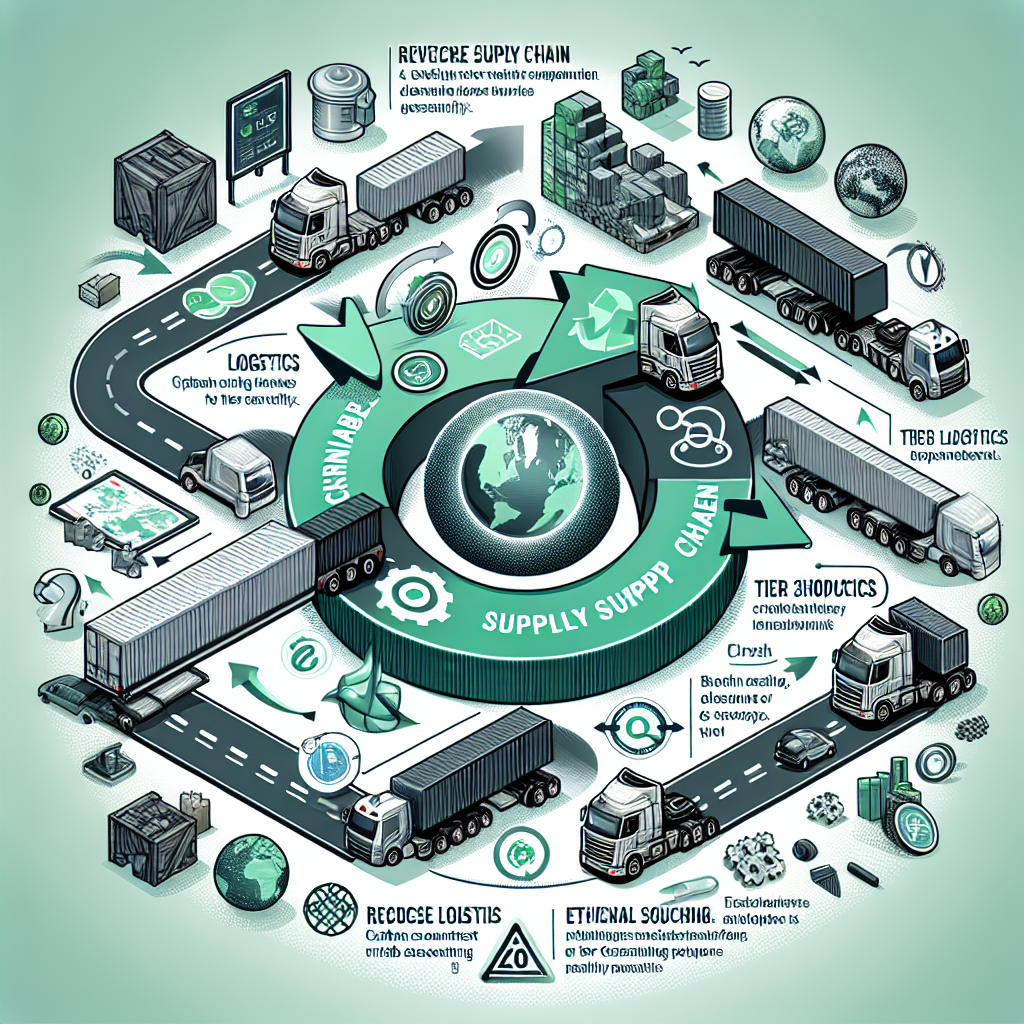
Getting products and materials back into the loop requires a serious investment in reverse logistics infrastructure. That means setting up collection points, managing returns efficiently, and sorting recovered materials so they can actually be reused rather than downcycled into lower-value streams.
Companies like Patagonia have turned reverse logistics for circularity into a brand differentiator with their Worn Wear program, which repairs, resells, and recycles gear. It’s not just good PR — it also generates data on which products fail, feeding back into better design decisions.
● Circularity means rethinking material flows, not just end-of-life disposal
● Reverse logistics programs create data loops that improve product design
● Remanufacturing can cut energy use by up to 80% compared to virgin production
Mapping Your Net-Zero Supply Chain Roadmap
Setting Science-Based Targets
A credible net-zero supply chain roadmap starts with Science Based Targets initiative (SBTi) alignment. That means setting reduction targets that are consistent with limiting global warming to 1.5°C — not just pledging to plant some trees. SBTi now has over 7,000 companies with approved or committed targets, so the methodology is well-tested and widely recognized.
The roadmap needs to cover Scope 1 (direct emissions), Scope 2 (purchased energy), and critically, Scope 3 — which typically accounts for 70–90% of a company’s total footprint and covers everything from raw material extraction to product end-of-life.
Scope 3 Emissions Tracking Without Losing Your Mind
Scope 3 emissions tracking is notoriously difficult because you’re relying on data from suppliers who may have wildly different reporting capabilities. The GHG Protocol’s Scope 3 standard breaks this into 15 categories, and most companies find that Categories 1 (purchased goods), 4 (upstream transportation), and 11 (use of sold products) are the biggest contributors worth tackling first.
Practical tools like Watershed, Persefoni, and Sweep are making it easier to ingest supplier data, apply spend-based or activity-based emission factors, and track progress over time. Pairing software with direct supplier engagement — like running workshops with your top 20 suppliers — gets you much closer to primary data rather than industry averages.
● SBTi provides a credible, globally recognized framework for net-zero commitments
● Scope 3 typically represents 70–90% of total corporate emissions
● Prioritize Categories 1, 4, and 11 for the biggest emission reduction impact
Carbon Accounting for Tier 3 Suppliers and Beyond
Most companies have reasonable visibility into Tier 1 suppliers, decent visibility into Tier 2, and almost none into Tier 3 and beyond. Yet that’s often where the highest environmental and social risks live — in mining operations, smallholder farms, and chemical plants that are many layers removed from the brand name on the final product.
Carbon accounting for Tier 3 suppliers requires a combination of supplier mapping technology and industry-level data standards. Initiatives like the Supplier Leadership on Climate Transition (SupplierLCA) and sector-specific programs in electronics (through the Responsible Business Alliance) are building shared databases that let companies pull credible emission factors without having to audit every sub-supplier individually.
The honest truth is that perfect data at Tier 3 isn’t realistic for most companies right now. The goal is to move from pure spend-based estimates toward hybrid models — using activity data where you can get it, and flagging high-risk spend categories for deeper investigation through supplier questionnaires or third-party audits.
● Tier 3+ suppliers often carry the highest environmental and social risk
● Shared industry databases reduce the burden of individual sub-supplier audits
● A hybrid data approach balances accuracy with practical feasibility
Sustainable Material Substitution Strategies
Switching to lower-impact materials is one of the most direct levers available, but sustainable material substitution isn’t as simple as swapping one input for another. You need to consider the full lifecycle — a bio-based plastic might have a lower carbon footprint but create land-use pressures, while recycled aluminum slashes energy use by 95% compared to primary production.
Interface, the modular flooring company, is a standout example. They’ve replaced petroleum-based yarn with recycled ocean plastic and bio-based nylon in their products, cutting product carbon footprints significantly while creating a compelling story for their business customers. Their published lifecycle assessment data lets buyers verify the claims rather than just take their word for it.
Working with your R&D and procurement teams to build a material substitution roadmap — prioritizing by volume, spend, and emission intensity — gives you a structured way to make progress without overhauling your entire product line at once. Tools like the Ellen MacArthur Foundation’s material guides and the Higg Materials Sustainability Index are genuinely useful starting points.
● Always evaluate material substitutions across the full lifecycle, not just carbon
● Recycled aluminum uses 95% less energy than primary production — a powerful substitution case
● Prioritize substitutions by volume, spend, and emission intensity for maximum impact
Green Logistics and the EV Fleet Transition
Transportation is one of the most visible and addressable sources of supply chain emissions. Green logistics and EV fleet transition programs are accelerating fast, driven by falling battery costs, expanding charging infrastructure, and fleet decarbonization mandates in markets like California, the UK, and the EU.
Amazon has committed to deploying 100,000 custom electric delivery vehicles from Rivian by 2030, and they’re already running thousands in U.S. cities. For companies that manage their own fleets, the business case for EV transition is increasingly straightforward on a total cost of ownership basis — especially for urban last-mile routes where EVs have the clearest operational advantages.
For companies that rely on third-party logistics providers rather than owning their own fleet, the lever is supplier selection and contract requirements. Including emissions intensity KPIs in logistics contracts, requiring carriers to report fuel consumption and vehicle type, and favoring providers with validated EV or alternative-fuel commitments all move the needle on Scope 3 Category 4 emissions without requiring you to own a single truck.
● EV total cost of ownership is increasingly competitive, especially for urban routes
● Third-party logistics contracts can include binding emissions KPIs
● Amazon’s 100,000-vehicle EV commitment with Rivian sets a benchmark for fleet transition ambition